- Version
- Download 15
- File Size 5.14 MB
- File Count 1
- Create Date March 12, 2026
- Last Updated March 12, 2026
New Index Reveals Governance Gaps, Gender Imbalance in Nigeria’s Host Community Trusts
A new independent assessment of Nigeria’s Host Community Development Trusts (HCDTs) has revealed significant governance weaknesses and persistent gender imbalance in institutions created under the Petroleum Industry Act (PIA) to channel oil wealth into community development.
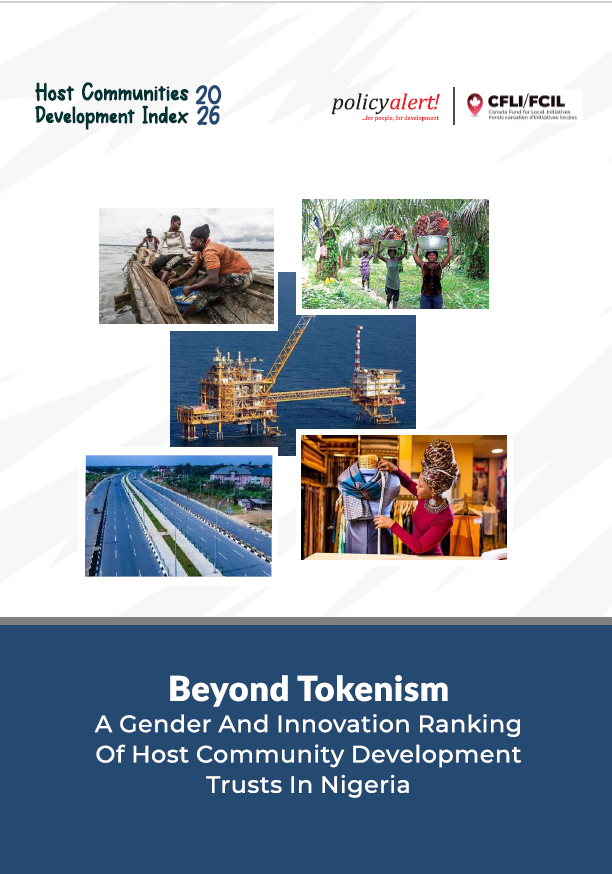
The findings are contained in the inaugural edition of the Host Communities Development Index (HCDI), launched, Monday, by Policy Alert at the 2026 Host Communities Development Forum in Port Harcourt, assesses Trust performance across four key pillars including governance and accountability, gender and social inclusion, environmental sustainability, and preparedness for the global energy transition.
The 2026 Index, a pilot that evaluated 18 Trusts across Rivers and Akwa Ibom States, found that while some Trusts are beginning to build credible governance systems, many still struggle with women’s representation, transparency, environmental responsibility, and readiness for the global energy transition.
According to the report, women remain significantly under-represented in the governance structures of most Trusts. In most instances, Trusts were making noticeable investments in gender-focused development programmes, but not supporting women’s participation in governing structures. Of the Trusts assessed, only one - Foursome HCDT, had up to 40 percent of Board positions held by women.Two Trusts scored zero across all environmental sustainability indicators, despite operating in environmentally vulnerable coastal communities.It also found that energy transition preparedness remains weak, with no Trust among the 18 assessed having developed a comprehensive transition strategy
Presenting the report, Policy Alert’s Executive Director, Tijah Bolton-Akpan, said the Index was designed to strengthen accountability within the emerging HCDT ecosystem.
“The promise of the PIA was that host communities would finally have a structured and transparent mechanism for deriving some benefits from the resource extraction happening in their backyards. The HCDT Index helps us measure whether that promise is being fulfilled,” he said. “Where Trusts are governed well, we are already seeing encouraging examples of community-driven development. But the Index also shows clear gaps in institutional capacity, transparency, inclusion, and long-term sustainability that must be addressed.”
Also speaking, Rt. Hon. Dumnamene Robinson Dekor, Chairman of the House of Representatives Committee on Host Communities, emphasized the importance of sustained oversight to ensure the PIA delivers justice for oil-producing communities.
“The National Assembly remains committed to ensuring that the provisions of the Petroleum Industry Act translate into real development for host communities,” Dekor said. “HCDTs were created to correct decades of imbalance in the oil sector, and for that reason we support initiatives such as this Index by Policy Alert as a tool for strengthening transparency and ensuring the PIA framework actually delivers to the people it was designed to serve.”
The HCDI 2026 reveals that weak governance structures, inconsistent funding, and limited transparency practices remain significant barriers to the effective functioning of several Trusts. Stakeholders at the Forum warned that unless these challenges are addressed, the HCDT framework risks falling short of its goal of delivering sustainable development to oil-producing communities.
To ensure that women benefit meaningfully from the HCDT framework, participants at the forum called for deliberate reforms, including a review of the relevant PIA regulations to prescribe Board quotas for women and budget thresholds for women-focused projects.