
On 13th August, Policy Alert, in partnership with BudgIT Foundation, convened a Capacity Strengthening Session for Host Community Development Trust (HCDT) Leadership in Akwa Ibom State. The session brought together chairpersons, management committee members, and trustees from across the state’s oil-producing communities to strengthen governance, accountability, inclusion, and resource mobilisation within their trusts. The session responds to a persistent gap in how HCDTs are typically understood and operated. Since the enactment of the Petroleum Industry Act (PIA) 2021, discussions around HCDTs have largely centred on the statutory 3% contribution oil companies are required to remit to host communities.
While this contribution remains an important compliance benchmark, an overreliance on it as the sole basis for HCDT operations limits the developmental potential the PIA was designed to unlock.
Positioning Statutory Contributions as a Foundation
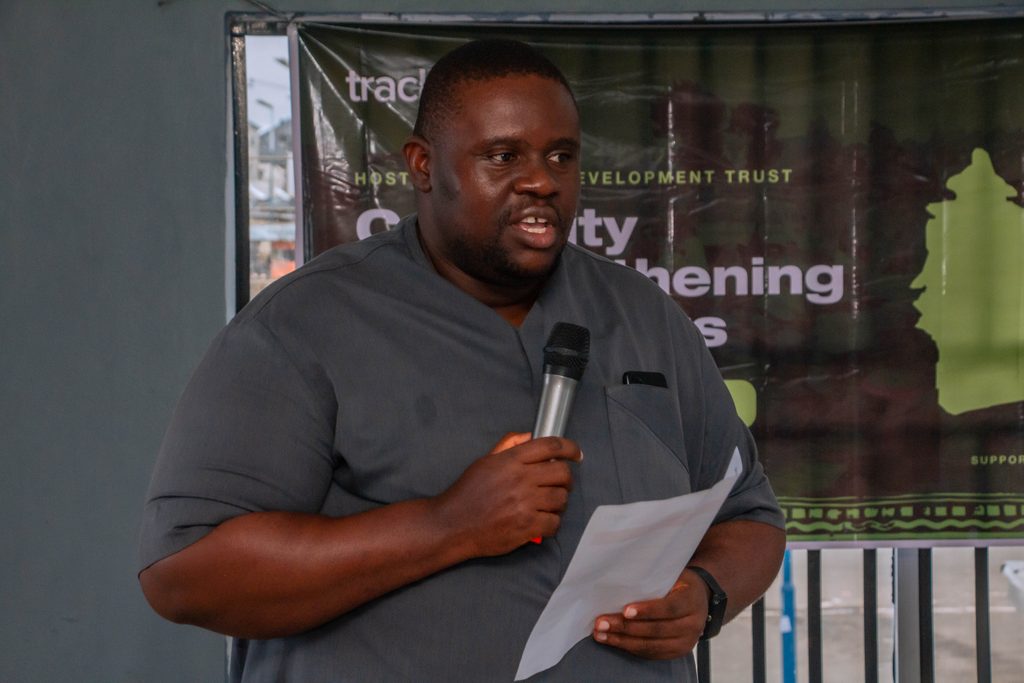
Edidiong Dickson, Head of the Energy, Extractives and Climate Justice Programme at Policy Alert, opened proceedings with a presentation titled “Beyond Statutory Funding: Positioning HCDTs for Grants and Partnerships.” He noted that Section 240(3) of the PIA provides a clear legal basis for HCDTs to receive donations, gifts, grants, and honoraria in addition to statutory contributions, provided such resources are applied toward the trust’s stated objectives.
Mr Dickson characterised statutory contributions as seed capital rather than a comprehensive funding solution, and called on HCDTs to adopt institutional practices comparable to those of established non-governmental organisations. He identified ten areas requiring deliberate institutional investment: institutional identity, good governance, strategic planning, professional financial management, programme management, monitoring and evaluation, documentation, evidence-building, resource mobilisation, and partnerships. He further recommended that HCDTs treat their five-year Community Development Plans not merely as regulatory compliance documents, but as strategic instruments capable of functioning simultaneously as a development strategy, programme pipeline, investment prospectus, partnership framework, and fundraising roadmap.
He advised that these plans be structured around clearly defined, fundable programme areas, including education and skills, health, livelihoods and enterprise, women and youth empowerment, environmental sustainability, climate resilience, infrastructure, energy access, and disability inclusion. Mr Dickson noted that prospective funders would assess HCDTs on the strength of their governance structures, financial systems, transparency mechanisms, programme capacity, safeguarding measures, and evidence of impact. He outlined six institutional improvements that could enhance HCDTs’ attractiveness to funders: professional documentation, stronger financial systems, institutionalised transparency, inclusion of women, young people, and persons with disabilities, evidence-based reporting, and strategic partnerships.
Measuring Outcomes, Not Just Outputs
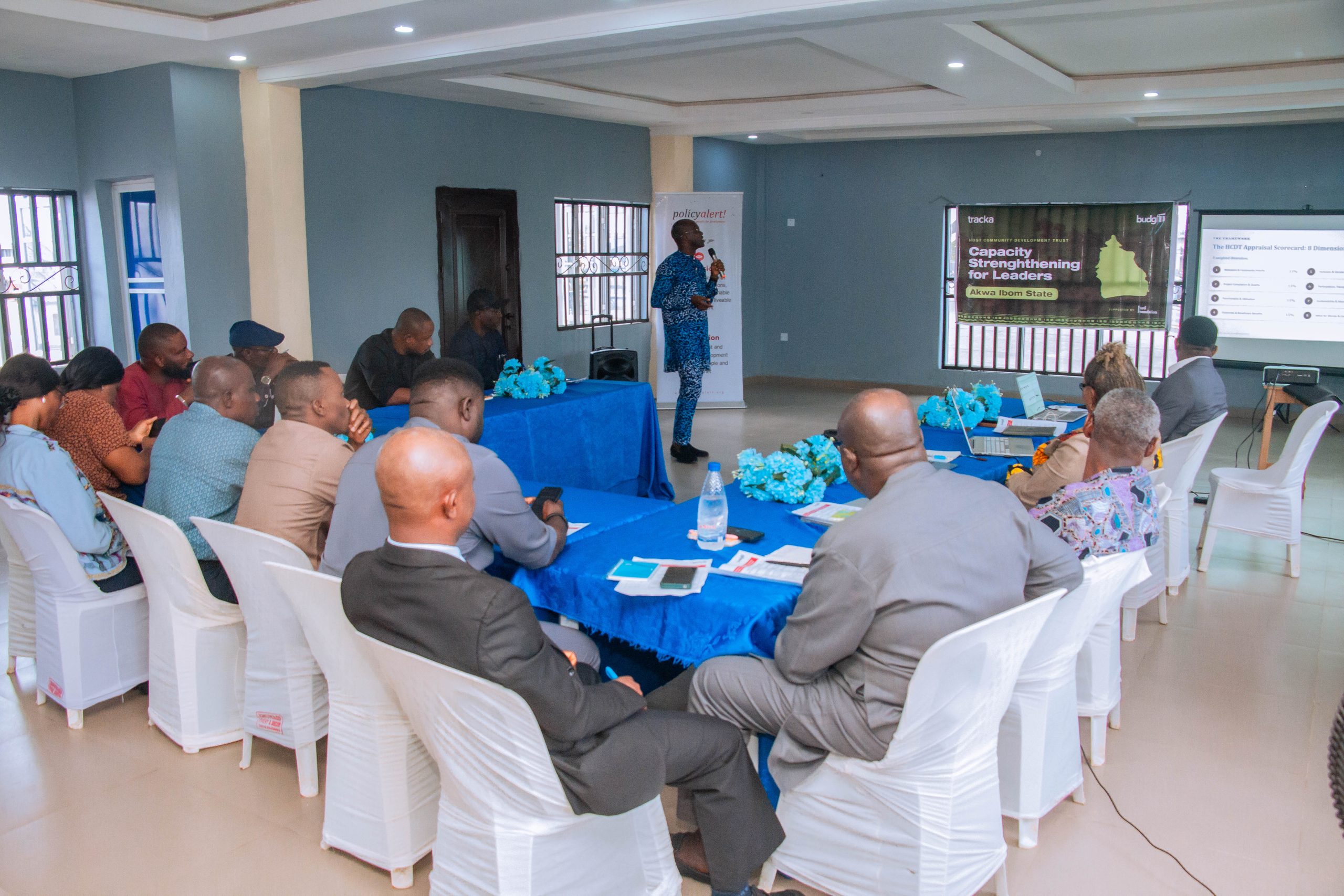
Dr Udo Koko, Programme Director at Policy Alert, presented a session on “Appraising HCDT Projects Against Standardised Monitoring and Evaluation Indicators.” He emphasised that project appraisal should extend beyond completion status to an assessment of demonstrated change, framed around two core questions: what evidence indicates progress toward stated objectives, and what has changed as a result of the intervention.
Dr Koko introduced an HCDT appraisal scorecard structured around eight weighted dimensions: relevance and community priority, inclusion and gender responsiveness, project completion and quality, participation, transparency and accountability, functionality and utilisation, sustainability and maintenance, value for money and cost effectiveness, and outcomes and beneficiary benefits. He indicated that consistent application of this framework would enable HCDTs to assess whether projects reflect genuine community priorities, meet acceptable delivery standards, remain functional over time, and produce sustainable benefit.
Addressing Persistent Gaps in Inclusion

Lucy Eyo, Programmes Officer and Gender Focal Person at Policy Alert, presented findings from an assessment of gender and social inclusion across nine HCDTs in Akwa Ibom State, in a session titled “Inclusion in HCDTs: What the Data Shows and What Improvement Would Look Like.” She noted that gender and social inclusion are legal requirements under the Nigeria Upstream Petroleum Host Communities Development Regulations 2022, citing Section 12(4), which mandates consideration of diversity, including age, gender, and physical disability, in appointments to leadership positions such as boards of trustees. The assessment identified appointments as the area of widest disparity among the indicators examined.
Ms Eyo noted that while HCDTs in Akwa Ibom State have recorded measurable governance gains, inclusion remains an area requiring sustained attention. She stated that women in oil-producing communities frequently bear a disproportionate share of the environmental and economic costs of extractive activity while having limited access to decision-making processes and associated benefits.
Ms Eyo recommended that HCDTs establish clear representation targets for women and marginalised groups across boards of trustees, management committees, and advisory committees; integrate gender and social inclusion considerations into community development plans; reserve dedicated opportunities within empowerment and livelihood programmes for women-led and other marginalised groups; and document actual participation in meetings and contract processes, rather than relying solely on invitation records. She further encouraged lower-performing HCDTs to draw on the practices of better-performing trusts within the state.
Reinforcing Compliance and Accountability

Enebi Opaoluwa, Head of Natural Resource and Climate Governance at BudgIT Foundation, addressed accountability and transparency mechanisms in HCDT operations. He outlined the statutory reporting obligations established under the PIA: the management committee’s submission of its mid-year activity report to the Board of Trustees by 31 August (Section 255(a)); its annual report and audited accounts to the Board by 28 February of the following year (Section 255(b)); the Board’s submission of the trust’s annual report and audited accounts to the settlor by 31 May (Section 255(c)); and the settlor’s onward submission to the relevant regulatory authority by 31 May (Section 255(d)), alongside the annual appointment of auditors under Section 254(b).
Mr Opaoluwa clarified the regulatory pathway available where a settlor fails to remit the statutory 3% contribution, advising that the Board of Trustees should formally notify the relevant authority, either the Nigerian Upstream Petroleum Regulatory Commission or the Nigerian Midstream and Downstream Petroleum Regulatory Authority, depending on the settlor’s operations. He noted that non-compliance may result in regulatory sanctions, including possible licence revocation under Section 238.
On project governance, he clarified the distinct roles within the HCDT structure: the Host Community Advisory Committee articulates community needs, the management committee identifies and recommends projects, and final approval authority rests with the Board of Trustees. He also noted that HCDT funds are exempt from income taxation under Section 256, while settlor contributions to HCDTs are deductible from hydrocarbon tax and companies income tax under Section 257.
The session underscored…
That the regulatory framework governing HCDTs already provides considerable scope for institutional development, diversified funding, and inclusive governance. The principal challenge identified was not one of legislative limitation, but of institutional practice. HCDT’s were encouraged to apply the tools and frameworks presented, the appraisal scorecard, inclusion targets, and the resource mobilisation roadmap, as ongoing institutional practice rather than one-time exercises.
For Policy Alert and BudgIT Foundation, continued investment in HCDT governance, accountability, inclusion, and resource mobilisation capacity remains central to ensuring that host communities in Akwa Ibom State realise the full developmental potential provided for under the Petroleum Industry Act.
